
Trucking Industry News - Page 4

FMCSA Clearinghouse Registration for Owner-Operators, Step by Step
If you run your own truck under your own USDOT number, FMCSA treats you as two people in the Drug and Alcohol Clearinghouse: the employer and the driver. Both have to be registered, and a consortium or third-party administrator (C/TPA) has to be designated in your account before you can run a single query. Here […]

EIN vs SSN for owner-operators: which one applies?
Sole prop with no employees can technically use an SSN. LLC, employees, 2290, factoring, and most banks require an EIN. Here is the exact decision tree.

How to get an EIN for trucking (step-by-step)
Free 10-minute EIN application directly on IRS.gov. Here is the exact sequence: entity setup, responsible party, online form, confirmation letter, and what to keep on file.

Do I need an EIN as an owner-operator?
Sole proprietors with no employees can legally use an SSN, but most banks, factoring companies, and insurers refuse to onboard a trucking business without an EIN. Here is the exact decision.

What happens if you miss the August 31 2290 deadline
Missed Form 2290 by August 31? Here is the exact penalty cascade, when DMV blocks plate renewal, and how to file late before it parks your truck.

How to file Form 2290 as a new owner-operator
Step-by-step Form 2290 (HVUT) filing walkthrough for new owner-operators: EIN, taxable gross weight, IRS e-file, payment, stamped Schedule 1, and what to keep for plate renewal.

Do I need to file Form 2290?
Form 2290 (HVUT) applies to most trucks at 55,000 lb GVW or more. Here is exactly when it is required, when it is not, and what triggers the filing.
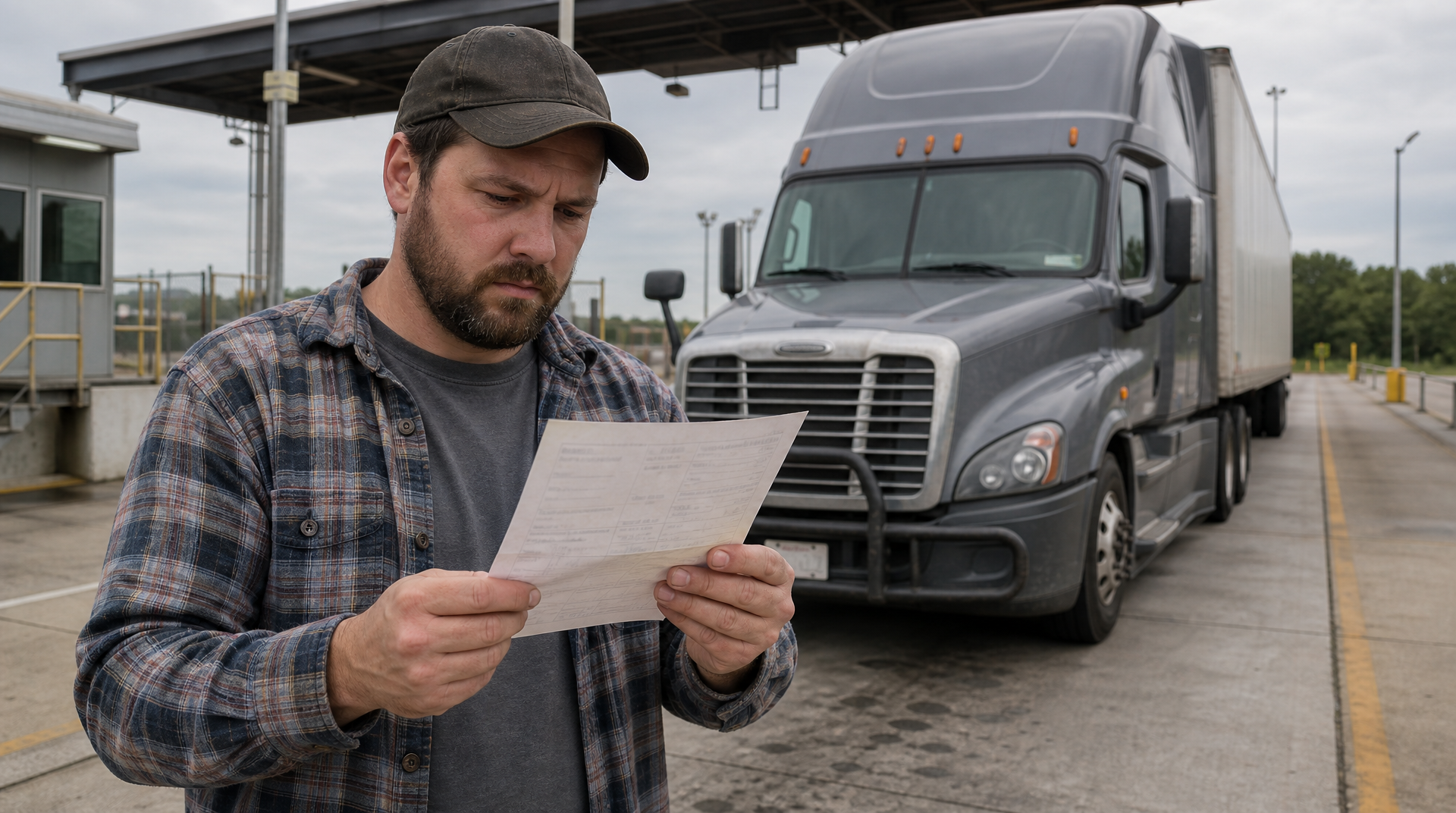
What happens if you operate without IRP (or let it lapse)
Operating interstate without IRP triggers weigh-station citations, possible out-of-service orders, and base-state plate suspension. Here is the full enforcement chain.

How to register IRP as a new owner-operator (step-by-step)
Step-by-step IRP registration for new owner-operators: base state, mileage projection, fee calculation, application, cab card, and what to keep for the truck.

Do I need IRP? (apportioned registration for owner-operators)
IRP applies if you cross state lines at 26,000+ lb GVW or 3+ axles. Here is exactly when apportioned plates are required, when single-state plates are enough, and when a trip permit covers it.