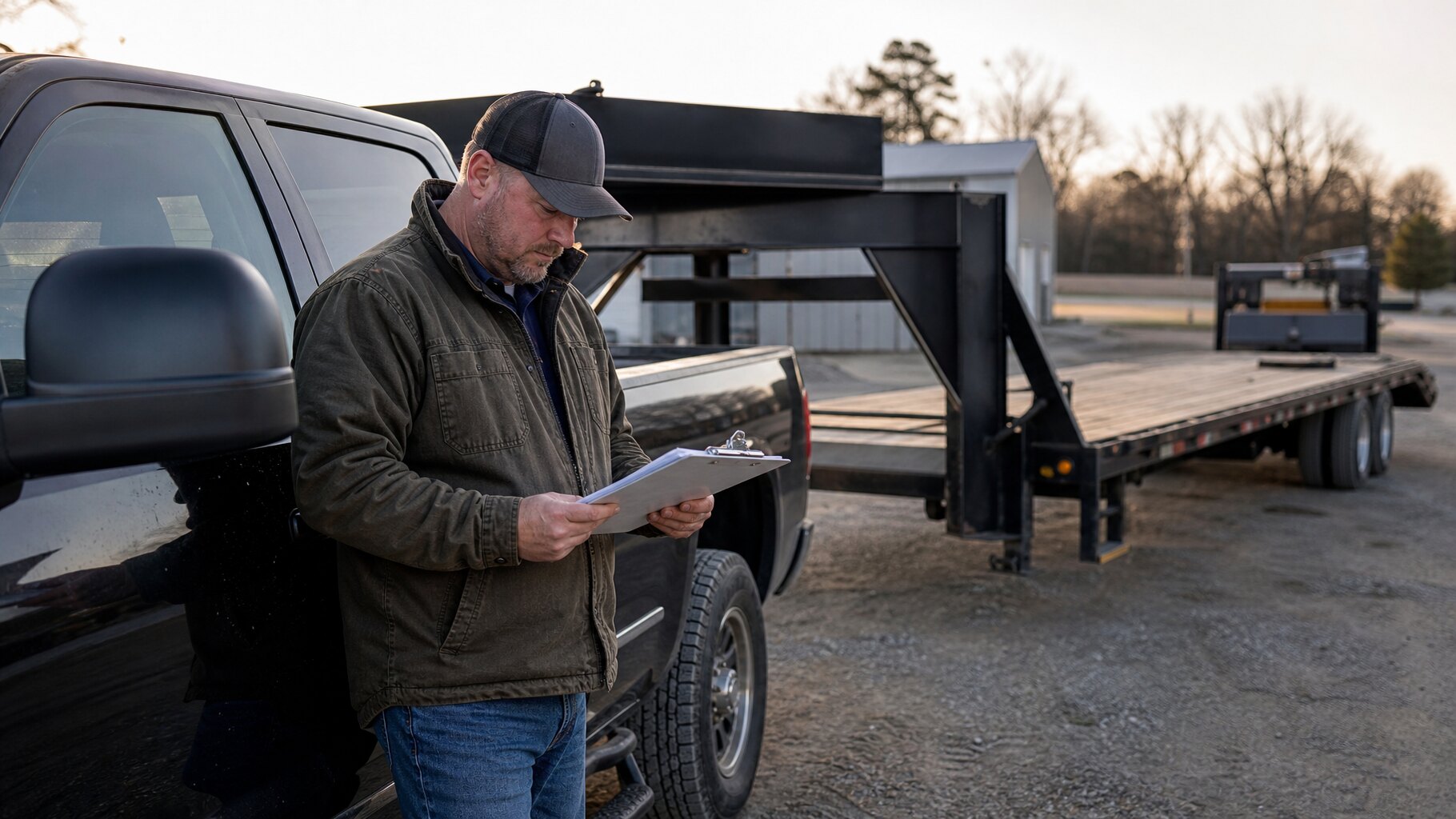
Yes, in most cases. If your business runs trucks of 10,001 pounds or more on New Jersey roads, New Jersey requires a USDOT number even if the trucks never leave the state. Under the federal rules alone, most carriers need one only once they are in interstate commerce. New Jersey’s own motor carrier safety rules take the same federal requirement and apply it to intrastate trucks.
This guide covers only the New Jersey side: which vehicles the state rule catches, what it says about the USDOT number, the hours of service limits that differ for intrastate drivers, and where the state rules stop and federal ones take over. It quotes N.J.A.C. 13:60-2.1, the New Jersey rule that adopts the Federal Motor Carrier Safety Regulations, in the version on Cornell LII, amended effective February 5, 2018. For the federal test itself, see do I need a USDOT number.
The short answer
N.J.A.C. 13:60-2.1(d) rewrites the federal USDOT registration rule for trucks that stay in New Jersey. The federal version, 49 CFR 392.9b(a), covers a commercial motor vehicle “providing transportation in interstate commerce.” The New Jersey version reads:
“A commercial motor vehicle providing transportation in intrastate commerce must not be operated without a USDOT registration and an active USDOT Number.”
The number the rule asks for is the federal USDOT number, not a separate state number. So the real question is whether your vehicle is a commercial motor vehicle under New Jersey’s definition.
What counts as a commercial motor vehicle in New Jersey
The same section changes the federal definition of a commercial motor vehicle (CMV) for intrastate work. In New Jersey a CMV is “any self-propelled or towed motor vehicle used on a highway in intrastate commerce to transport passengers or property” when it meets any one of these:
- It “has a gross vehicle weight rating or gross combination weight rating, or a registered weight of 4,536 kg (10,001 pounds) or more, whichever is greater.”
- It is designed or used to carry more than 8 passengers, including the driver, for compensation.
- It is designed or used to carry more than 15 passengers, including the driver, not for compensation.
- It carries hazardous materials in a quantity that requires placards, “or the vehicle displays a hazardous material(s) placard.”
Three details differ from the federal definition in 49 CFR 390.5T:
- Intrastate. The federal definition starts with “in interstate commerce.” New Jersey’s starts with “in intrastate commerce.”
- Registered weight counts. New Jersey looks at the GVWR, the GCWR or the weight the vehicle is registered for, whichever is greater. If you registered a truck for more than its rating, the registered weight is the number that matters. Where the federal definition counts the actual gross weight, New Jersey’s counts the registered weight.
- A placard alone is enough. Under the New Jersey wording, a vehicle that displays a hazmat placard is a CMV, whatever it is carrying that day.
The definition says nothing about who owns the freight. A contractor moving its own equipment and a for-hire carrier moving someone else’s both fit it if the vehicle meets the weight or passenger test. Combinations count too: a work pickup towing a trailer is a CMV if the combination rating is 10,001 pounds or more.
Who the rules do not cover
Farm vehicles are exempt under N.J.A.C. 13:60-1.2(c). The chapter does not apply to a farm vehicle registered in New Jersey under N.J.S.A. 39:3-24 and 39:3-25 while it operates inside the state and is not carrying hazardous materials in a placarded quantity or displaying placards. If you think you qualify, read the exact conditions in the rule before you skip registration.
The chapter also reaches further than many owners expect. It applies to carriers running “wholly within a municipality or a municipality’s commercial zone,” so a truck that only works inside one town is still covered.
USDOT registration
Need the USDOT number and nothing else?
USDOT Number Only: $75, single DOT registration. Not sure? We offer a free compliance consultation to help determine your exact needs.
Get StartedThe federal safety rules come with it
The USDOT number is the visible part. N.J.A.C. 13:60-2.1 adopts the Federal Motor Carrier Safety Regulations by reference, “except as may be indicated in this chapter.” The adopted parts include:
- Part 40 and Part 382, drug and alcohol testing
- Part 383, commercial driver’s license standards
- Part 391, qualifications of drivers
- Part 392, driving of motor vehicles
- Part 393, parts and accessories necessary for safe operation
- Part 395, hours of service of drivers
- Part 396, inspection, repair and maintenance
The full list also covers Parts 325, 350, 355, 380, 384, 385, 387, 388, 390, 397 and 398, plus Appendices F and G. The rule also says later federal amendments are adopted “as if set forth in full.” Under N.J.A.C. 13:60-1.2(b), everyone involved in managing, maintaining or driving the vehicles “shall be conversant and knowledgeable” with these rules. Going intrastate does not get you a lighter rulebook. Apart from New Jersey’s own changes, such as those in 13:60-2.1(d), it is the federal one.
Hours of service for New Jersey intrastate drivers
Hours of service are where New Jersey changes the federal numbers, and only for driving “while operating in intrastate commerce.” For property-carrying drivers:
| Limit | Federal, 49 CFR 395.3 | New Jersey intrastate, N.J.A.C. 13:60-2.1(d) |
|---|---|---|
| Driving window after 10 hours off duty | 14 consecutive hours | 16 consecutive hours |
| Driving time in that window | 11 hours | 12 hours |
| Carrier does not operate every day | 60 hours in 7 days | 70 hours in 7 days |
| Carrier operates every day | 70 hours in 8 days | 80 hours in 8 days |
Within Part 395, section (d) changes only those limits. The rest of the part is adopted by reference. Once a driver runs a trip in interstate commerce, the federal limits in the left column apply instead.
Getting and keeping the number
The USDOT number comes from FMCSA, not from the New Jersey Motor Vehicle Commission (NJ MVC). You apply online through FMCSA’s registration system. Our guide on how to apply for a USDOT number online walks through the steps.
Getting the number is only half of it. New Jersey asks for an active USDOT number. Federally, the registration record has to be updated every 24 months on a schedule set by the last two digits of the number, and missing it can mean “deactivation of its USDOT Number” under 49 CFR 390.19T. Part 390 is one of the parts New Jersey adopts. See our guide to the MCS-150 biennial update for the filing schedule.
Registering the truck itself in New Jersey
The USDOT number identifies your company to FMCSA. Registering the vehicles with NJ MVC is a separate step. NJ MVC issues an Entity Identification Number to businesses located in New Jersey, which it describes as “a 15-digit EIN that will be required for all transactions.” MVC adds that the EIN “was formerly known as Corporation Code.” It is not the same as the federal EIN from the IRS. If your company does not have one yet, see New Jersey Corporation Code registration.
When the federal rules take over
The New Jersey changes cover intrastate work only. Interstate commerce is wider than crossing the state line. A load that comes from or goes to another state or country can count even if your truck stays in New Jersey, and a trip between two New Jersey points that passes through another state counts too. Once you are in interstate commerce:
- The federal registration rule, 49 CFR 392.9b, applies. You still need the USDOT number.
- The federal hours of service limits replace the New Jersey ones.
- If you haul regulated freight for hire, you may also need operating authority, the MC number.
If you are not sure which side of the line your runs fall on, settle that first. The federal test is the same in every state.
Rules quoted from N.J.A.C. 13:60-1.2 and 13:60-2.1 (as amended effective February 5, 2018) and from 49 CFR 390.5T, 390.19T, 392.9b and 395.3 on eCFR, as read on November 16, 2026. NJ MVC wording is from its business EIN page. Rules change, so check the current text before you rely on it. This is not legal advice.