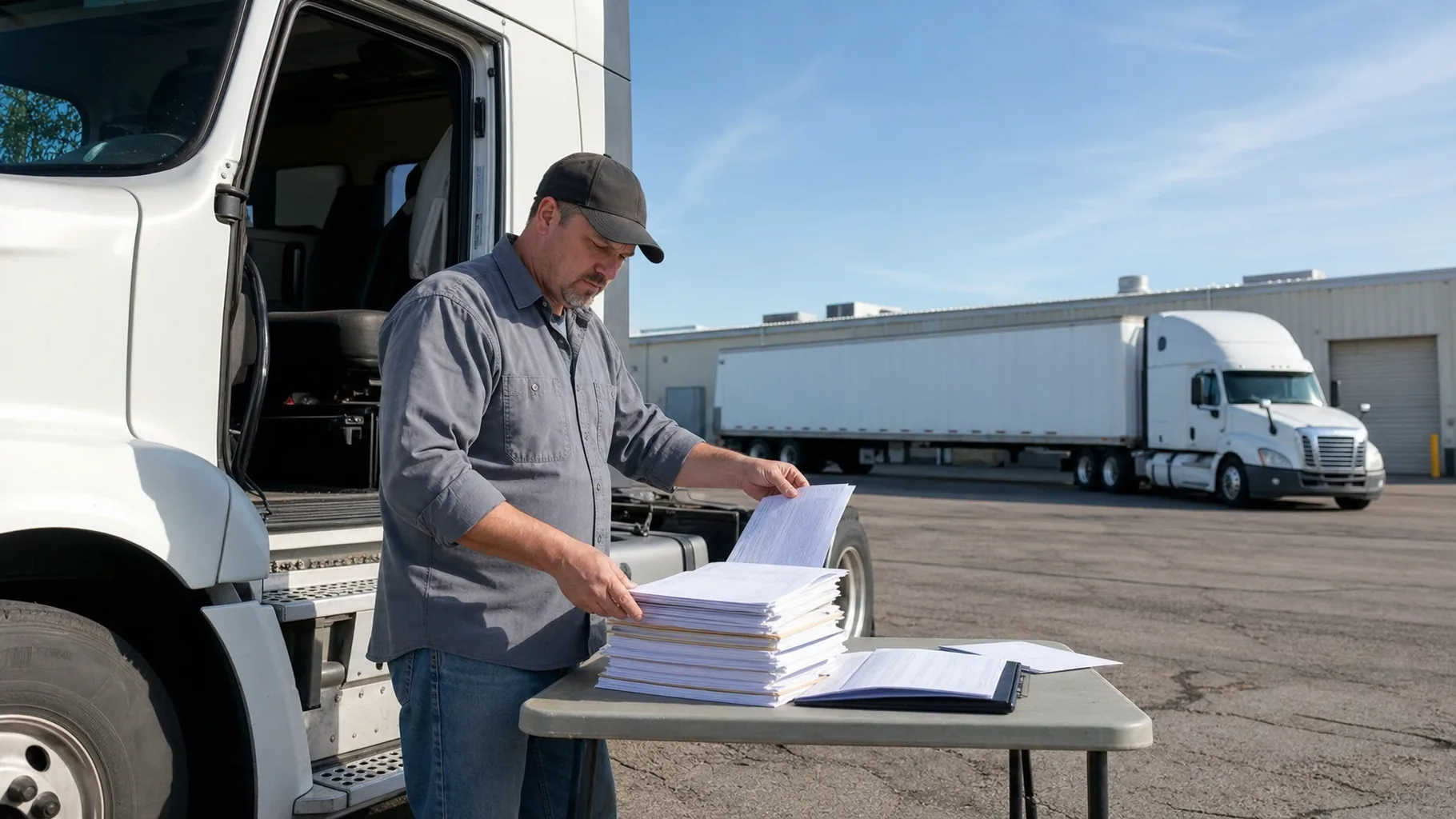
If you have just activated MC authority and your truck will cross state lines, IRP is the next base-state filing between you and your first compliant interstate trip. Short answer: the IRP apportioned registration process is filed in your base state, requires a current 2290 Schedule 1 plus mileage projections by jurisdiction, and produces a single set of apportioned plates with a cab card listing every state and Canadian province your truck is registered to enter. Most owner-operators finish the application in a single afternoon once the prep checklist is in front of them; the part that costs time is the order of operations, not the form itself.
You are here → MC active → 2290 filed → now you file IRP.
If you are not yet sure whether IRP actually applies to your truck. Read Do I need IRP? first to confirm the threshold. This walk-through assumes the answer is yes.
When in the year IRP has to be filed
| Scenario | When to file |
|---|---|
| New MC authority, no IRP yet | Before first interstate trip |
| Existing IRP, annual renewal | Base-state renewal cycle (often March 31, varies) |
| Adding a new truck mid-year | Within 30 days of acquisition or first interstate use |
| Removing a truck | At renewal, or with supplemental for prorated refund |
Initial IRP processing typically takes 1-3 weeks depending on the base state. Some states issue temporary cab cards while plates are being made; others require the full processing window before the truck can roll interstate. Knowing which one your base state does is what determines whether IRP needs to be filed three weeks before your first dispatch or one week before.
What to have on hand before you start
Before you open the IRP application, gather these. The base-state office checks each item against an existing database, having them ready prevents the back-and-forth that turns a one-afternoon filing into a two-week one:
- Active USDOT and MC numbers. The base-state IRP office cross-references both. Inactive or revoked authority blocks IRP issuance.
- EIN (Employer Identification Number). The IRP application uses the carrier’s EIN, not the operator’s SSN.
- Stamped 2290 Schedule 1 (current tax year). Required for any truck above 55,000 lb. The IRS HVUT (Heavy Vehicle Use Tax) database is checked directly.
- Vehicle title or lease agreement. Original or certified copy. Lease agreements must show the truck is in the carrier’s operating fleet.
- Proof of business address in the base state. Lease agreement, utility bill, or business license. Base state must be where the business is established and the truck is garaged.
- Estimated mileage by jurisdiction (first-time filers). A reasonable projection of how many miles the truck will run in each state and province during the year. Returning filers use actual prior-year mileage.
- Vehicle specifications. VIN, make, model, year, fuel type, axle count, declared GVW.
- Insurance proof. Some states require a commercial auto insurance certificate at IRP application; most check it through FMCSA.
IRP weight categories and apportioned fees
IRP fees are calculated by the declared gross vehicle weight (GVW) and the percentage of miles the truck will run in each jurisdiction. The base-state IRP office calculates the apportionment automatically from the mileage you submit:
| Declared GVW | Fee category (typical) |
|---|---|
| 26,001-50,000 lb | Light-medium |
| 50,001-65,000 lb | Medium-heavy |
| 65,001-80,000 lb | Standard tractor (most owner-operators) |
| 80,001+ lb | Heavy-haul / oversize |
Each jurisdiction sets its own per-mile fee schedule. The base state collects all fees and distributes them to the apportioned jurisdictions. Operators receive one invoice from the base state, not one per state.
Filing IRP step by step
Here’s how IRP registration actually works in practice. Most new owner-operators move through this in one sitting once the prep is ready:
- Confirm your base state. The base state must be where the business is registered, where the truck is normally garaged, and where business records are maintained. For owner-operators, this is typically your home state, but only if the truck is also garaged there.
- Project annual mileage by jurisdiction. List every state and Canadian province the truck will enter, with estimated miles in each. First-time filers: be realistic, not optimistic. Underestimating leads to audit reassessment.
- Declare the truck’s GVW. Use the highest weight you intend to operate at, including loaded trailers. Declaring lower than actual is a violation flagged at weigh stations.
- Submit the application via your base state’s online portal. Most states have moved to electronic filing (e.g., Texas TxIRP, California IRP, Florida MyDMV Portal). A few still use paper applications.
- Pay the apportioned fee. One invoice covers all jurisdictions. Payment by credit card, ACH, or certified check, varies by state. Total typically lands at $1,200-$2,500 for a single-truck owner-operator running 10 states.
- Receive your apportioned plates and cab card. Plates are issued by the base state. The cab card lists every jurisdiction the truck is registered to enter. Both must be in the truck before the first interstate trip.
- Keep the cab card in the truck. Most weigh stations require the original or a certified copy. A photo on the driver’s phone is not always accepted.
- Note the renewal date. Base-state renewal cycles vary. A calendar reminder 30 days out keeps the renewal from lapsing into a same-week scramble.
If this feels like more base-state coordination than you want to handle on top of MC activation, 2290 filing, and IFTA setup, that’s exactly the cluster of timing-dependent filings where a missed step parks the truck. Our IRP apportioned registration service files the application in your base state with current 2290 cross-checked, mileage projection prepared, and the cab card delivered before the truck rolls.
Where IRP applications get held up
Most IRP delays come from a small set of data mismatches, recoverable once you know what the office is checking, but each one costs days while the file sits on hold.
Wrong base state. Filing in a state where the truck is not actually garaged or the business is not registered triggers rejection. New owner-operators sometimes pick a state with lower fees. Base-state IRP offices verify residency and reject mismatches.
Missing 2290 Schedule 1. The most common holdup. New owner-operators sometimes file out of order, assuming IRP comes first. The order of operations is: EIN → MC → 2290 → IRP. The IRP office checks the IRS HVUT database directly, so a 2290 that hasn’t been processed yet shows as missing even if you filed it last week.
Incorrect mileage projection. Underestimating mileage to lower fees triggers audit reassessment with penalty. Overestimating wastes money on fees never used. First-time filers should project conservatively but realistically. Most experienced owner-operators land at 80,000-120,000 annual miles on a single truck.
GVW declared lower than actual. Declaring 65,000 lb but operating at 78,000 lb is a flagged discrepancy at any weigh station. The citation costs more than the higher GVW fee would have.
Common IRP mistakes that delay the cab card
- Application before MC activation. Filing IRP while the MC is still pending or revoked gets the application held. Wait until MC is “Active,” the operating-authority status governed by 49 CFR § 392.9a.
- Wrong VIN or fuel type on the form. Small typos hold the file until corrected. Most common: VIN digit error, gasoline declared instead of diesel.
- Insurance not on file. Some states (CA, NY) check insurance through FMCSA before issuing IRP. If your BOC-3 + insurance filings are still in progress, the IRP application will wait on them.
- Filing on the last business day. Some base-state offices process on a 5-7 business-day cycle. Filing on the deadline means processing finishes after the renewal lapses, even if the application was on time.
- Missing supplemental for new trucks. Adding a truck mid-year requires a separate supplemental, not a new full application.
Quick recap before you file
- Order of operations: EIN → MC → 2290 → IRP, never reverse
- Prep: USDOT, MC, EIN, current 2290 Schedule 1, title/lease, insurance, mileage projection, declared GVW
- Submit through your base-state IRP portal, pay one apportioned invoice
- Cab card stays in the truck before the first interstate trip
- Renewal annual: calendar reminder 30 days out
IRP vs IFTA vs UCR: separate registrations, same base state
- IRP: plates and cab card, annual, base-state.
- IFTA: fuel tax, quarterly, base-state, separate license.
- UCR: annual fee per power unit, home state.
All three are filed in the same base state but on different cycles with different agencies. They are not bundled. If you’re deciding between plate types, see IRP vs single-state plates.
Next step
If you are stepping into interstate operation under new MC authority and the IRP application is the next thing on the list, the timing matters more than the form itself, current 2290 first, mileage projection accurate, base state verified. We coordinate the IRP apportioned registration in your base state so the cab card is in the truck before the first interstate trip. See how our IRP apportioned registration service works →